
Toyota 4Runner: Back Door Lock
Components
COMPONENTS
ILLUSTRATION
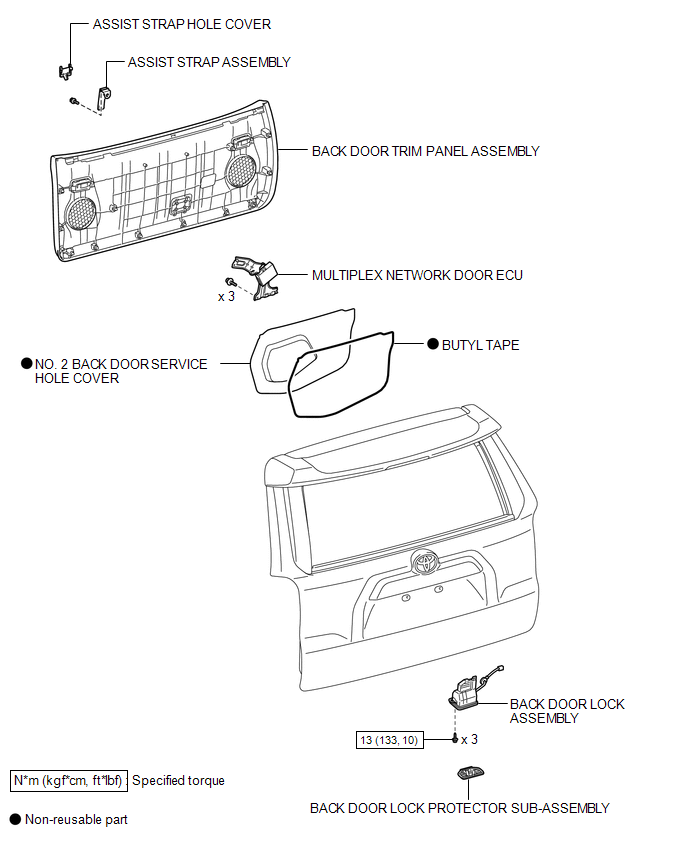
Removal
REMOVAL
PROCEDURE
1. REMOVE BACK DOOR LOCK PROTECTOR SUB-ASSEMBLY
.gif)
2. REMOVE ASSIST STRAP HOLE COVER
3. REMOVE ASSIST STRAP ASSEMBLY
4. REMOVE BACK DOOR TRIM PANEL ASSEMBLY
5. REMOVE MULTIPLEX NETWORK DOOR ECU
6. REMOVE NO. 2 BACK DOOR SERVICE HOLE COVER
7. REMOVE BACK DOOR LOCK ASSEMBLY
|
(a) Detach the 2 clamps and claw. |
|
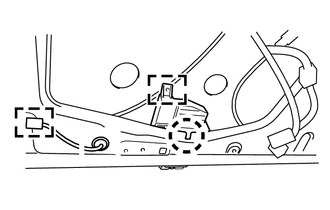
|
(b) Disconnect the connector. |
|
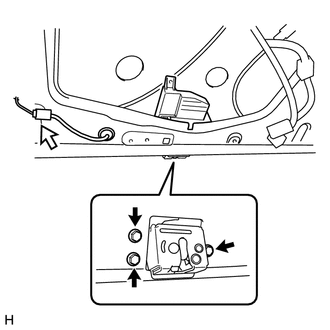
(c) Remove the 3 bolts and back door lock assembly.
Inspection
INSPECTION
PROCEDURE
1. INSPECT BACK DOOR LOCK ASSEMBLY
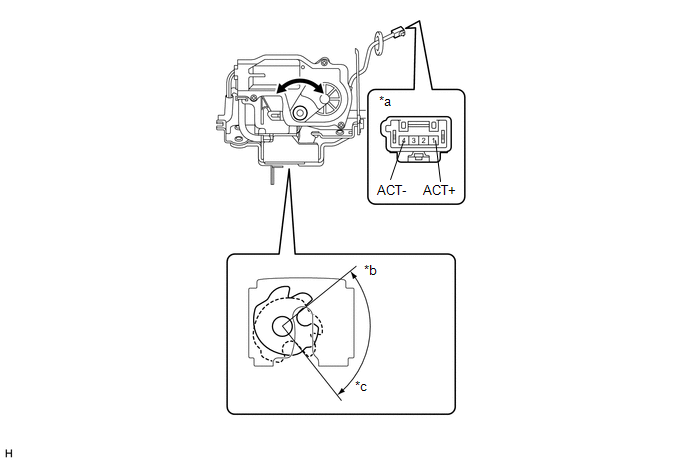
(a) Set the back door lock to the full-latch position.
(b) Apply battery voltage to the door motor connector and check the operation of the door lock motor.
OK:
|
Measurement Condition |
Specified Condition |
|---|---|
|
Battery positive (+) → 1 (ACT+) Battery negative (-) → 4 (ACT-) |
Moves to open-latch position |
- If the result is not as specified, replace the back door lock assembly.
(c) Measure the resistance according to the value(s) in the table below.
Standard Resistance:
|
Tester Connection |
Condition |
Specified Condition |
|---|---|---|
|
3 (E) - 2 (S) |
Open-latch |
Below 1 Ω |
|
3 (E) - 2 (S) |
Full-latch |
10 kΩ or higher |
- If the result is not as specified, replace the back door lock assembly.
|
*a |
Component without harness connected (Back Door Lock Assembly) |
|
*b |
Full-latch |
|
*c |
Open-latch |
Installation
INSTALLATION
PROCEDURE
1. INSTALL BACK DOOR LOCK ASSEMBLY
|
(a) Install the back door lock assembly with the 3 bolts. Torque: 13 N·m {133 kgf·cm, 10 ft·lbf} |
|
.png)
(b) Connect the connector.
|
(c) Attach the 2 clamps and claw. |
|
.png)
2. INSTALL NO. 2 BACK DOOR SERVICE HOLE COVER
.gif)
3. INSTALL MULTIPLEX NETWORK DOOR ECU
4. INSTALL BACK DOOR TRIM PANEL ASSEMBLY
5. INSTALL ASSIST STRAP ASSEMBLY
6. INSTALL ASSIST STRAP HOLE COVER
7. INSTALL BACK DOOR LOCK PROTECTOR SUB-ASSEMBLY
 Door Lock
...

Other materials about Toyota 4Runner:
Data List / Active Test
DATA LIST / ACTIVE TEST
1. DATA LIST
HINT:
Using the Techstream to read the Data List allows the values or states of switches,
sensors, actuators and other items to be read without removing any parts. This non-intrusive
inspection can be very useful bec ...
Confirm Cellular Phone Functionality
PROCEDURE
1.
CHECK THE CUSTOMER'S CELLULAR PHONE COMPATIBILITY
(a) Go to TIS "Bluetooth" Compatibility Portal and check if the cellular phone
is compatible.
Result
Proceed to
...

0.0249