
Toyota 4Runner: If your vehicle has to be stopped in an emergency
Only in an emergency, such as if it becomes impossible to stop the vehicle in the normal way, stop the vehicle using the following procedure:
 Steadily step on the brake pedal
with both feet and firmly depress it.
Do not pump the brake pedal repeatedly as this will increase the effort required to slow the vehicle.
 Shift the shift lever to N.
If the shift lever is shifted to N
 After slowing down, stop
the vehicle in a safe place by the road.
 Stop the engine.
If the shift lever cannot be shifted to N
Keep depressing the brake pedal
with both feet to reduce vehicle speed as much as possible.
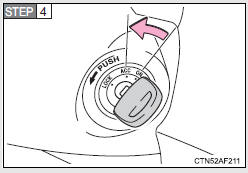
Vehicles without a smart key system: Stop the engine by turning the engine switch to the “ACC” position.
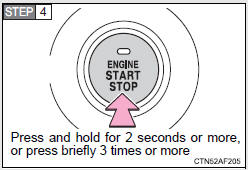
Vehicles with a smart key system: To stop the engine, press and hold the “ENGINE START STOP” switch for 2 consecutive seconds or more, or press it briefly 3 times or more in succession.

Stop the vehicle in a safe place by the road.
CAUTION
If the engine has to be turned off while driving
• Power assist for the brakes and steering wheel will be lost, making the brake pedal harder to depress and the steering wheel heavier to turn.
Decelerate as much as possible before turning off the engine.
• Vehicles without a smart key system: Never attempt to remove the key, as doing so will lock the steering wheel.
 If the vehicle becomes stuck
Carry out the following procedures if the tires spin or the vehicle
becomes stuck in mud, dirt or snow:
Stop the engine. Set the parking
brake and shift the shift lever to P.
Remove the mud, s ...
 Vehicle specifications
Detailed vehicle information. ...
Other materials about Toyota 4Runner:
Relay(w/ Ptc Heater)
On-vehicle Inspection
ON-VEHICLE INSPECTION
PROCEDURE
1. REMOVE PTC HEATER RELAY (PTC NO. 1, PTC NO. 1, PTC NO. 3)
(a) Remove the 3 PTC heater relays from the engine room relay block.
Text in Illustration
*1
...
Problem Symptoms Table
PROBLEM SYMPTOMS TABLE
HINT:
Use the table below to help determine the cause of problem symptoms. If multiple
suspected areas are listed, the potential causes of the symptoms are listed in order
of probability in the "Suspected Area" column of ...

0.0124