
Toyota 4Runner: Four-wheel drive system (part-time 4WD models)
Use the front-wheel drive control lever or switch to select the following transfer modes:
Type A
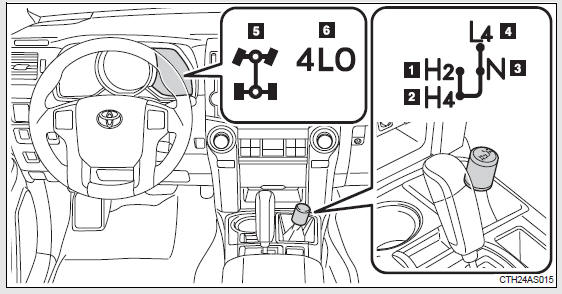
The four-wheel drive indicator comes on when H4, N or L4 mode is selected.
1. H2 (high speed position, two-wheel drive)
Use this for normal driving on dry hard-surfaced roads. This position gives greater economy, quietest ride and least wear.
2. H4 (high speed position, four-wheel drive)
Use this for driving only on tracks that permit the tires slide, like offroad, icy or snow-covered roads. This position provides greater traction than two-wheel drive.
3. N (neutral position)
No power is delivered to the wheels. The vehicle must be stopped.
4. L4 (low speed position, four-wheel drive)
Use this for maximum power and traction. Use “L4” for climbing or descending steep hills, off-road driving, and hard pulling in sand, mud or deep snow.
5. Four-wheel drive indicator
6. Low speed four-wheel drive indicator
Type B
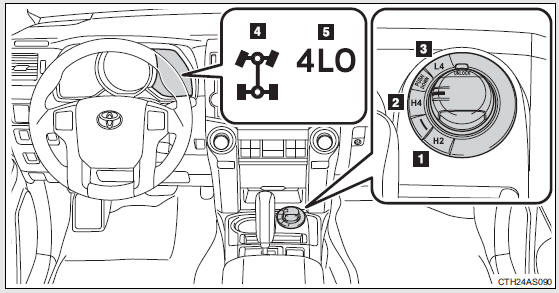
The four-wheel drive indicator comes on when H4 or L4 mode is selected.
1. H2 (high speed position, two-wheel drive)
Use this for normal driving on dry hard-surfaced roads. This position gives greater economy, quietest ride and least wear.
2. H4 (high speed position, four-wheel drive)
Use this for driving only on tracks that permit the tires slide, like offroad, icy or snow-covered roads. This position provides greater traction than two-wheel drive.
3. L4 (low speed position, four-wheel drive)
Use this for maximum power and traction.
Use “L4” for climbing or descending steep hills, off-road driving, and hard pulling in sand, mud or deep snow.
4. Four-wheel drive indicator
5. Low speed four-wheel drive indicator
 Rear view monitor system (rear view mirror-attached type)
The rear view monitor assists the driver by displaying an image of the
area behind the vehicle while reversing. The image is displayed in reverse on
the screen. This reversed image is a similar im ...
 Shifting between H2 and H4
Shifting from H2 to H4
Type A
Reduce vehicle speed to less
than 50 mph (80 km/h).
Shift the front-wheel drive
control lever to H4.
Type B
Reduce vehicle speed to less
than 62 mph (100 km/ ...
Other materials about Toyota 4Runner:
High Power Supply Voltage Malfunction (C1417)
DESCRIPTION
If a malfunction is detected in the power supply circuit, the skid control ECU
(housed in the master cylinder solenoid) stores this DTC and the fail-safe function
prohibits ABS/VSC/TRAC operation.
This DTC is stored when the IG1 terminal volt ...
How To Proceed With Troubleshooting
CAUTION / NOTICE / HINT
HINT:
Use these procedures to troubleshoot the lighting system.
*: Use the Techstream.
PROCEDURE
1.
VEHICLE BROUGHT TO WORKSHOP
NEXT
...

0.025