
Toyota 4Runner: Motor LH Current Senser (62,63)
DESCRIPTION
When the side auto step motor current detection sensor inside the side auto step controller ECU assembly detects a current of less than 1 A when the automatic running board is operating, the side auto step controller ECU assembly does not operate the automatic running board.
|
DTC No. |
Detection Condition |
Trouble Area |
|---|---|---|
|
61 |
When the side auto step motor assembly LH is operating, there is less than 1 A of current detected in the side auto step ECU even when the hall effect pluses are input. |
|
|
62 |
When the side auto step motor assembly RH is operating, there is less than 1 A of current detected in the side auto step ECU even when the hall effect pluses are input. |
WIRING DIAGRAM
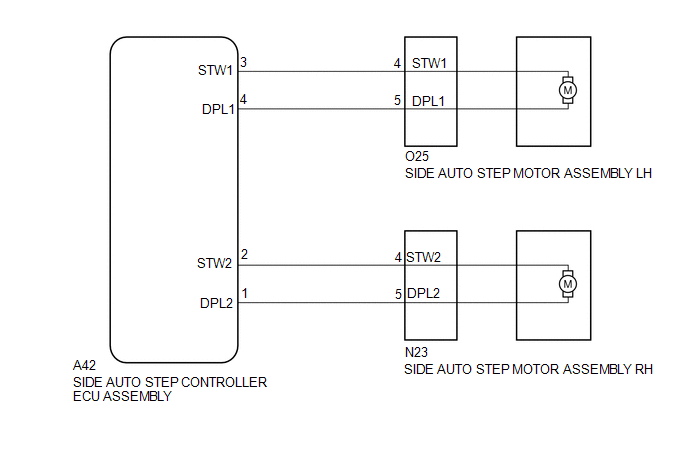
PROCEDURE
|
1. |
CHECK HARNESS AND CONNECTOR (SIDE AUTO STEP MOTOR - SIDE AUTO STEP CONTROLLER ECU) |
(a) Disconnect the O25*1 or N23*2 side auto step motor assembly connector.
- *1: for LH
- *2: for RH
(b) Disconnect the A42 side auto step controller ECU assembly connector.
(c) Measure the resistance according to the value(s) in the table below.
Standard Resistance:
for LH
|
Tester Connection |
Condition |
Specified Condition |
|---|---|---|
|
O25-4 (STW1) - A42-3 (STW1) |
Always |
Below 1 Ω |
|
O25-5 (DPL1) - A42-4 (DPL1) |
Always |
Below 1 Ω |
for RH
|
Tester Connection |
Condition |
Specified Condition |
|---|---|---|
|
N23-4 (STW2) - A42-2 (STW2) |
Always |
Below 1 Ω |
|
N23-5 (DPL2) - A42-1 (DPL1) |
Always |
Below 1 Ω |
| NG | .gif) |
REPAIR OR REPLACE HARNESS OR CONNECTOR |
|
.gif)
|
2. |
PERFORM COOL DOWN |
(a) Do not operate the automatic running board in order to cool down the side auto step motor assembly.
|
|
3. |
CHECK DTC |
(a) Recheck for DTCs and check if the same DTC is output again.
OK:
No DTCs are output.
| OK | |
END |
| NG | |
REPLACE SIDE AUTO STEP CONTROLLER ECU ASSEMBLY |
 Motor LH Over Temperature (64,65)
DESCRIPTION
When the side auto step controller ECU assembly detects the overheating in the
system, it stops the operation of the automatic running board.
DTC No.
Detection Co ...
 ECU Circuit (61)
DESCRIPTION
When the internal circuit of the side auto step controller ECU assembly malfunctions,
the side auto step controller ECU assembly halts the operation of the system.
DTC No.
...
Other materials about Toyota 4Runner:
Headlight Dimmer Switch Circuit
DESCRIPTION
The main body ECU receives the following signals:
Headlight dimmer switch tail, head, AUTO*, high or high flash signal
Front fog light switch signal
*: w/ Automatic Light Control System
WIRING DIAGRAM
PROCEDU ...
How To Proceed With Troubleshooting
CAUTION / NOTICE / HINT
HINT:
*: Use the Techstream.
PROCEDURE
1.
VEHICLE BROUGHT TO WORKSHOP
NEXT
2.
INSPECT BATTERY VOLTAGE
...

0.0269