
Toyota 4Runner: Radio Broadcast cannot be Received or Poor Reception
PROCEDURE
|
1. |
CHECK RADIO AND DISPLAY RECEIVER ASSEMBLY |
(a) Check the radio automatic station search function.
(1) Check the radio automatic station search function by activating it.
|
Result |
Proceed to |
|---|---|
|
Automatic station search function does not stop |
A |
|
Automatic station search function stops on a station |
B |
| B | .gif) |
REPLACE RADIO AND DISPLAY RECEIVER ASSEMBLY |
|
.gif)
|
2. |
CHECK OPTIONAL COMPONENTS |
(a) Check if any optional components that may decrease reception capacity, such as sunshade film or a telephone antenna, are installed.
|
Result |
Proceed to |
|---|---|
|
Optional components are not installed |
A |
|
Optional components are installed |
B |
NOTICE:
Do not remove optional components without the permission of the customer.
| B | |
REMOVE OPTIONAL COMPONENTS AND CHECK AGAIN (SEE NOTICE ABOVE) |
|
|
3. |
CHECK RADIO AND DISPLAY RECEIVER ASSEMBLY |
|
(a) Preparation for check (1) Remove the antenna connector from the radio and display receiver assembly. |
|
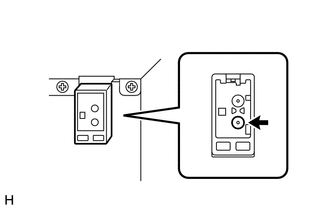
(b) Check for noise
(1) Turn the ignition switch to ACC with the radio and display receiver assembly connector connected.
(2) Turn the radio on and tune into AM mode.
(3) Place a screwdriver, thin wire or other metal object on the radio and display receiver assembly antenna jack and check that noise can be heard from the speakers.
OK:
Noise can be heard from the speakers.
| NG | |
REPLACE RADIO AND DISPLAY RECEIVER ASSEMBLY |
|
|
4. |
CHECK WINDOW GLASS ANTENNA WIRE |
|
(a) Check for continuity in the window glass antenna wire. HINT: Check for continuity at the center of each antenna wire as shown in the illustration. NOTICE: When cleaning the glass, wipe it in the direction of the wire with a soft dry cloth. Take care not to damage the wire. Do not use detergents or glass cleaners with abrasive ingredients. When measuring resistance, wrap a piece of tin foil around the tip of each probe and press the foil against the wire with your finger, as shown in the illustration. OK: There is continuity in the window glass antenna wire. Text in Illustration
|
|
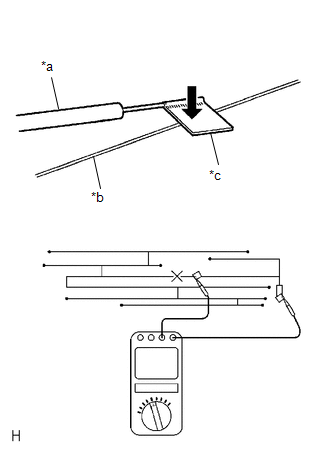
| NG | |
REPAIR WINDOW GLASS ANTENNA WIRE |
|
|
5. |
INSPECT RADIO AND DISPLAY RECEIVER ASSEMBLY |
(a) Disconnect the radio and display receiver assembly connector.
|
(b) Measure the voltage according to the value(s) in the table below. Standard Voltage:
|
|
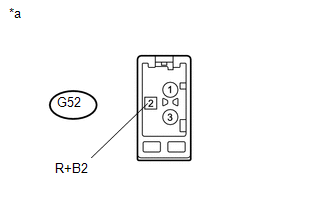
| NG | |
REPLACE RADIO AND DISPLAY RECEIVER ASSEMBLY |
|
|
6. |
REPLACE AMPLIFIER ANTENNA ASSEMBLY |
(a) Replace the amplifier antenna assembly and check if radio broadcasts can
be received normally (See page .gif) ).
).
OK:
Radio broadcasts can be received normally.
| OK | |
NORMAL OPERATION |
|
|
7. |
REPLACE NO. 2 ANTENNA CORD SUB-ASSEMBLY |
(a) Replace the No. 2 antenna cord sub-assembly and check if radio broadcasts
can be received normally (See page ).
OK:
Radio broadcasts can be received normally.
| OK | |
NORMAL OPERATION |
|
|
8. |
REPLACE NO. 2 INSTRUMENT PANEL WIRE |
(a) Replace the No. 2 instrument panel wire and check if radio broadcasts can
be received normally (See page ).
OK:
Radio broadcasts can be received normally.
| OK | |
NORMAL OPERATION |
| NG | |
REPLACE RADIO AND DISPLAY RECEIVER ASSEMBLY |
 CD Sound Skips
PROCEDURE
1.
CHECK CD
(a) Check that the CD is not deformed or cracked.
OK:
No deformation or cracks on the CD
...
 Illumination for Panel Switch does not Come on with Tail Switch ON
PROCEDURE
1.
CHECK VEHICLE SIGNAL (OPERATION CHECK)
(a) Enter the "Vehicle Signal Check Mode" screen. Refer to Check Vehicle Signal
in Operation Check (Se ...
Other materials about Toyota 4Runner:
Removal
REMOVAL
CAUTION / NOTICE / HINT
HINT:
Use the same procedure for the RH and LH sides.
The procedure listed below is for the LH side.
PROCEDURE
1. DISCONNECT CABLE FROM NEGATIVE BATTERY TERMINAL
CAUTION:
Wait at least 90 seconds after d ...
Mute Signal Circuit between Stereo Component Amplifier and Telematics Transceiver
DESCRIPTION
The DCM (telematics transceiver) sends a mute signal to the stereo component
amplifier assembly.
The stereo component amplifier assembly controls the volume according to the
mute signal from the DCM (telematics transceiver).
WIRING DIAGRAM
...

0.0075