
Toyota 4Runner: Removal
REMOVAL
CAUTION / NOTICE / HINT
NOTICE:
Be sure to read the precaution before performing this procedure (See page
.gif) ).
).
HINT:
- Use the same procedure for the RH and LH sides.
- The procedure listed below is for the LH side.
PROCEDURE
1. REMOVE FRONT WHEEL
2. REMOVE LOWER FRONT BUMPER COVER
3. REMOVE NO. 1 ENGINE UNDER COVER SUB-ASSEMBLY
4. REMOVE FRONT SUSPENSION MEMBER BRACE SUB-ASSEMBLY
5. REMOVE FRONT STABILIZER END BRACKET (w/ KDSS)
6. REMOVE FRONT STABILIZER BAR (w/ KDSS)
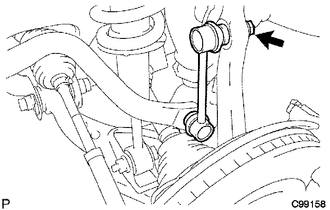
7. DISCONNECT FRONT STABILIZER LINK ASSEMBLY LH (w/o KDSS)
|
(a) Remove the nut and disconnect the stabilizer link from the steering knuckle. HINT: If the ball joint turns together with the nut, use a 6 mm hexagon wrench to hold the stud. |
|
8. DISCONNECT FRONT STABILIZER LINK ASSEMBLY RH (w/o KDSS)
HINT:
Use the same procedure described for the LH side.
9. REMOVE FRONT NO. 1 STABILIZER BRACKET LH (w/o KDSS)
10. REMOVE FRONT NO. 1 STABILIZER BRACKET RH (w/o KDSS)
11. REMOVE FRONT STABILIZER BAR (w/o KDSS)
12. REMOVE FRONT SHOCK ABSORBER WITH COIL SPRING (w/ REAS)
NOTICE:
Perform this procedure with the vehicle jacked up so that all the shock absorbers are extended.
|
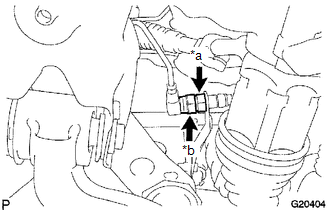
(a) As shown in the illustration, loosen the nut and disconnect the tube. Text in Illustration
NOTICE: Never loosen the absorber hoses or the flare nuts at the joint parts. |
|
|
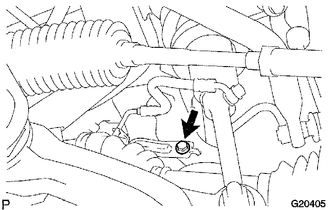
(b) Remove the bolt and bracket. |
|
|
(c) Remove the bolt, nut and washer. |
|
.png)
|
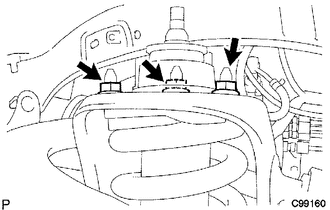
(d) Remove the 3 nuts on the top of the front shock absorber with coil spring. |
|
13. REMOVE FRONT SHOCK ABSORBER WITH COIL SPRING (w/o REAS)
|
(a) Remove the bolt, nut and washer. |
|
|
(b) Remove the 3 nuts on the top of the front shock absorber with coil spring. |
|
(c) Remove the front shock absorber with coil spring.
 Components
COMPONENTS
ILLUSTRATION
ILLUSTRATION
ILLUSTRATION
...
 Disassembly
DISASSEMBLY
PROCEDURE
1. REMOVE FRONT SUPPORT TO FRONT SHOCK ABSORBER NUT
(a) Secure SST in a vise.
SST: 09727-30021
09727-00010
09727-00031
SST: 09727-00060
...
Other materials about Toyota 4Runner:
Problem Symptoms Table
PROBLEM SYMPTOMS TABLE
HINT:
Use the table below to help determine the cause of problem symptoms.
If multiple suspected areas are listed, the potential causes of the symptoms
are listed in order of probability in the "Suspected Area" ...
Lost Communication with Combination Meter (B2661,B2662)
DESCRIPTION
This DTC is stored when LIN communication between the drive monitor switch and
combination meter assembly stops 10 seconds or more.
DTC Code
DTC Detection Condition
Trouble Area
B2661
...

0.0079